
Chronic inflammation is one of the most thoroughly documented contributors to the development and progression of the major non-communicable diseases that define the modern health burden, from cardiovascular disease and type 2 diabetes to neurodegenerative conditions and several cancers. The mechanisms by which low-grade systemic inflammation accumulates over years and decades, driven by a combination of dietary patterns, lifestyle factors, gut microbiome dysbiosis and environmental exposures, have been the subject of intense research that has gradually illuminated the specific molecular pathways involved.
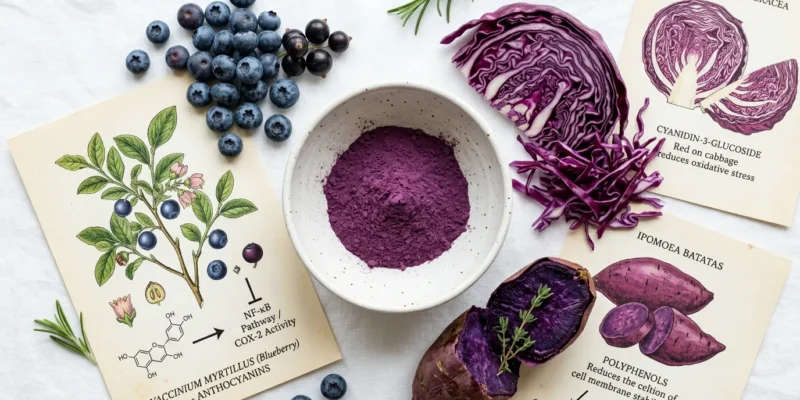
Against this background, the question of which dietary components can meaningfully modulate inflammatory signalling has genuine clinical relevance. Anthocyanins, the plant pigments responsible for the purple, blue and red colours of a wide range of fruits, vegetables and root crops, have emerged as among the most biologically active dietary anti-inflammatory compounds, with evidence from epidemiological studies, randomised controlled trials and mechanistic research that is more consistent than that for most other dietary compounds claimed to have anti-inflammatory properties.
The relationship between anthocyanins and inflammation is directly relevant to the ube latte explored in our guide to ube latte wellness benefits, where ube’s unusually stable acylated anthocyanin profile positions it as one of the most effective dietary anthocyanin sources for anti-inflammatory purposes.
The molecular mechanisms of anthocyanin anti-inflammatory activity
The anti-inflammatory effects of anthocyanins operate through multiple distinct molecular mechanisms that converge on the major inflammatory signalling pathways, giving them a breadth of anti-inflammatory action that is unusual among dietary phytochemicals.
Inhibition of NF-kB activation is the most centrally important mechanism. NF-kB is the master transcription factor that regulates the expression of the majority of pro-inflammatory genes, including those encoding inflammatory cytokines such as TNF-alpha, IL-1 beta and IL-6, inflammatory enzymes including COX-2 and iNOS, and cell adhesion molecules involved in inflammatory cell recruitment. Multiple in vitro and animal studies have demonstrated that anthocyanins inhibit NF-kB activation through several upstream mechanisms, and human intervention studies have documented reductions in NF-kB activity in peripheral blood cells following dietary anthocyanin intervention.
Activation of Nrf2 is the complementary mechanism. Nrf2 is a transcription factor that regulates the expression of antioxidant and cytoprotective genes, providing cellular defence against oxidative stress that would otherwise amplify inflammatory signalling. Anthocyanins activate Nrf2 through modification of the Keap1 protein that normally keeps Nrf2 sequestered in the cytoplasm, allowing Nrf2 to translocate to the nucleus where it activates the antioxidant response element. This Nrf2 activation complements the NF-kB inhibition to produce a coordinated shift in cellular gene expression away from pro-inflammatory and toward anti-inflammatory and cytoprotective profiles.
Direct inhibition of COX-2 and LOX enzymes, the enzymes that produce pro-inflammatory prostaglandins and leukotrienes from arachidonic acid, has been demonstrated for several anthocyanin compounds in enzyme inhibition assays, providing a mechanism analogous to that of non-steroidal anti-inflammatory drugs but without the gastrointestinal toxicity associated with prolonged NSAID use.
Clinical evidence from human intervention studies
The mechanistic evidence for anthocyanin anti-inflammatory effects is complemented by a growing body of human clinical trial evidence that documents measurable reductions in circulating inflammatory biomarkers following dietary anthocyanin interventions.
A systematic review and meta-analysis published in Nutrients in 2021 analysed fourteen randomised controlled trials investigating the effect of anthocyanin-rich food interventions on circulating inflammatory markers. The pooled analysis demonstrated significant reductions in CRP, the most widely used clinical marker of systemic inflammation, and in IL-6 and TNF-alpha concentrations following anthocyanin intervention compared to control, with effect sizes that were consistent across different anthocyanin sources and study populations.
The most extensively studied anthocyanin sources in human clinical trials are blueberries and bilberries, both of which have produced consistent anti-inflammatory effects across multiple independently conducted trials. Studies using standardised bilberry extract, purple corn anthocyanins and mixed berry preparations have produced comparable effects, suggesting that the anti-inflammatory activity is a class effect of anthocyanins rather than being specific to particular compounds or sources.
Anthocyanins and gut-mediated inflammation
One of the most significant insights from recent anthocyanin research concerns the role of gut microbiome modulation as a mechanism through which anthocyanins produce systemic anti-inflammatory effects. The gut microbiome is increasingly recognised as a major determinant of systemic inflammatory tone, with dysbiotic microbiome compositions associated with increased intestinal permeability, greater translocation of bacterial endotoxins into the systemic circulation, and chronic activation of innate immune inflammatory signalling.
Anthocyanins selectively increase the abundance of bacterial species associated with reduced gut permeability and lower systemic inflammatory tone, particularly Akkermansia muciniphila, which maintains the mucus layer that forms the first line of defence against bacterial translocation, and Bifidobacterium species, which produce short-chain fatty acids that support colonocyte health and tight junction integrity.
This gut-mediated anti-inflammatory mechanism is distinct from and complementary to the direct anti-inflammatory effects of anthocyanins on inflammatory signalling pathways, meaning that regular anthocyanin consumption produces anti-inflammatory effects through at least two independent mechanisms that reinforce each other over time.






Comments