
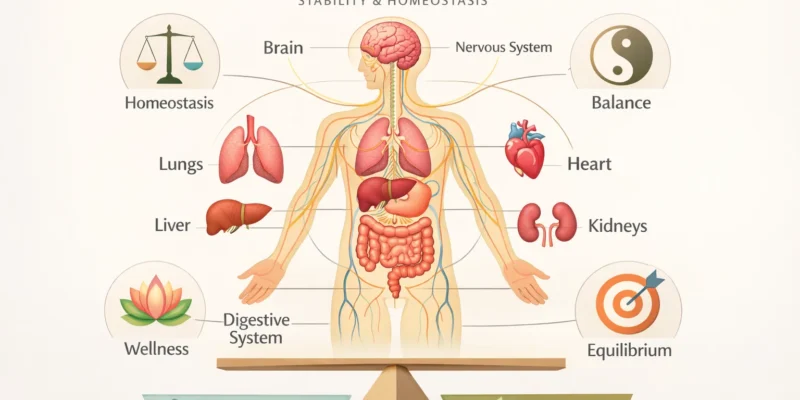
Homeostasis is the body’s built-in regulatory process that keeps internal conditions stable despite constant change. Temperature, blood sugar, hormone levels, hydration, and neural activity are all tightly regulated to remain within functional ranges. When this balance is maintained, physical and mental systems operate efficiently. When it is disrupted, even slightly, the effects can cascade across multiple areas of health.
- The Core Principle of Biological Balance
- Mental Health and Homeostatic Regulation
- Physical Systems Under Constant Adjustment
- The Role of the Nervous System
- Hormonal Feedback Loops
- Adaptation Versus Overcompensation
- Lifestyle Factors That Influence Balance
- Biological Signaling and Regulatory Support
- Early Signs of Homeostatic Disruption
- Long-Term Stability and Resilience
The Core Principle of Biological Balance
At its foundation, homeostasis is about equilibrium. Cells, tissues, and organs rely on precise internal conditions to perform their roles. The nervous system, endocrine system, and immune system continuously communicate to correct deviations before they become problematic.
This process happens automatically and silently. Most people only become aware of homeostasis when it begins to fail, such as during chronic stress, illness, or prolonged sleep disruption. These situations push regulatory systems beyond their adaptive capacity, leading to fatigue, mood changes, or physical discomfort.
Mental Health and Homeostatic Regulation
Mental balance is closely tied to neurochemical stability. Neurotransmitters such as serotonin, dopamine, and GABA must remain within specific ranges to support emotional regulation, focus, and stress resilience. Homeostatic mechanisms control the release, reuptake, and degradation of these signaling molecules.
When stress becomes persistent, the brain shifts into a defensive state. Cortisol production increases, and regulatory feedback loops lose efficiency. Over time, this imbalance can affect mood stability, cognitive clarity, and emotional responsiveness. Homeostasis does not eliminate stress but determines how effectively the brain returns to baseline after activation.
Physical Systems Under Constant Adjustment
The body’s physical systems are equally dependent on balance. Blood glucose regulation, inflammatory responses, muscle tension, and digestive activity are all governed by feedback loops designed to maintain stability. Small disruptions are normal and expected, but chronic imbalance places strain on these systems.
For example, prolonged inflammation signals that immune regulation is no longer adaptive. Digestive irregularities may indicate disrupted gut-brain communication. These signals are not isolated issues but reflections of broader regulatory challenges within the body.
The Role of the Nervous System
The autonomic nervous system plays a central role in maintaining homeostasis. It consists of the sympathetic branch, responsible for activation and alertness, and the parasympathetic branch, responsible for rest and recovery. A healthy system shifts fluidly between these states.
Modern lifestyles often favor prolonged sympathetic activation. Continuous stimulation, irregular sleep, and cognitive overload reduce opportunities for parasympathetic recovery. Over time, this imbalance affects heart rate variability, immune response, and emotional regulation, all key indicators of homeostatic health.
Hormonal Feedback Loops
Hormones act as messengers that help coordinate long-range communication within the body. Insulin, cortisol, melatonin, and thyroid hormones are regulated through feedback loops designed to prevent excess or deficiency.
Disruption in one hormonal pathway often affects others. Sleep deprivation can alter cortisol rhythms, which then influence blood sugar regulation and appetite signaling. These interconnected effects demonstrate how homeostasis functions as a network rather than a collection of isolated systems.
Adaptation Versus Overcompensation
Healthy homeostasis is adaptive. It allows the body to respond to challenges and return to equilibrium efficiently. Problems arise when adaptation turns into overcompensation. Chronic stress, restrictive diets, or excessive stimulation can push regulatory systems into rigid patterns.
In these cases, the body maintains stability at a cost. Elevated stress hormones may become the new baseline. Digestive function may slow or accelerate unnaturally. Mental clarity may fluctuate unpredictably. These shifts indicate that homeostasis is being preserved through strain rather than flexibility.
Lifestyle Factors That Influence Balance
Daily habits significantly affect homeostatic efficiency. Sleep consistency, nutrient intake, hydration, movement, and exposure to natural light all provide signals that help regulatory systems calibrate properly. Irregular routines confuse these signals and increase the likelihood of imbalance.
Psychological factors also play a role. Perceived stress, emotional suppression, and cognitive overload influence nervous system activity. Even without physical threats, the brain can trigger physiological responses that disrupt internal equilibrium.
Biological Signaling and Regulatory Support
Research into internal signaling systems highlights how the body maintains balance at a molecular level. The endocannabinoid system, for instance, contributes to fine-tuning stress responses, immune signaling, and neural communication. Understanding how CBD interacts with the endocannabinoid system has brought attention to the importance of supporting existing regulatory pathways rather than forcing directional outcomes.
This perspective reinforces the idea that balance is achieved through modulation, not domination. Supporting regulatory systems allows the body to recalibrate itself instead of relying on external overrides.
Early Signs of Homeostatic Disruption
Subtle symptoms often appear before major dysfunction. Difficulty concentrating, inconsistent energy levels, increased sensitivity to stress, and changes in appetite or sleep patterns can all indicate that regulatory systems are under strain.
These signs are not isolated problems to suppress. They are feedback signals. Recognizing them early allows for adjustments that restore balance before compensation becomes chronic.
Long-Term Stability and Resilience
Resilience is a direct outcome of effective homeostasis. A balanced system responds to challenges without becoming stuck in reactive states. Mental resilience, physical recovery, and emotional flexibility all reflect how well internal regulation is functioning.
Rather than chasing short-term fixes, focusing on balance supports sustainable well-being. Homeostasis is not a static state but a dynamic process that adapts continuously. Understanding its role provides a framework for interpreting both mental and physical health signals with greater clarity.









Comments