
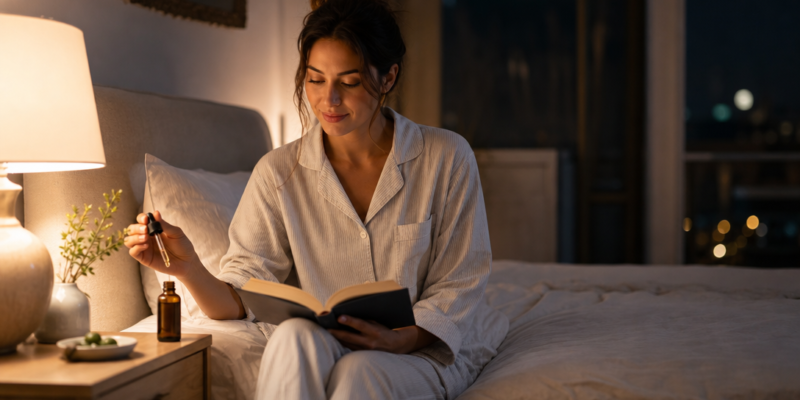
Sleep problems are remarkably common, and the range of things people try to address them is equally wide. Magnesium, melatonin, valerian root, weighted blankets, strict sleep schedules — the list goes on. CBD has joined that list in a significant way over the past few years, and the questions people ask about it tend to be the same: does it actually do anything, and if so, how?
How CBD might interact with sleep
CBD does not work like a sedative. It does not force the body into sleep the way antihistamines or certain prescription medications do. Its relationship with sleep, if there is one, appears to be more indirect.
The endocannabinoid system plays a role in regulating several physiological processes, including the sleep-wake cycle. CB1 receptors, found throughout the brain and central nervous system, are involved in modulating arousal and circadian rhythm. CBD interacts with this system, though not in the same way as THC, and does not produce any intoxicating effect.
One mechanism researchers have looked at is CBD’s potential influence on anxiety. Poor sleep and anxiety are closely linked — a mind that will not settle at night is one of the most frequently reported reasons for difficulty falling asleep. If CBD reduces the physiological and psychological markers of anxiety, the downstream effect could be improved sleep onset, even if CBD is not acting on sleep directly.
There is also some evidence suggesting CBD may affect REM sleep in people with certain conditions, particularly those involving REM sleep behaviour disorder. But this remains an area where research is still relatively thin.
What the research actually shows
The honest answer is that the evidence is promising but not conclusive. A frequently cited 2019 study published in The Permanente Journal found that anxiety scores decreased in the majority of participants and sleep scores improved in roughly two thirds of them within the first month of CBD use. The study was small and uncontrolled, which limits how much weight it can carry, but the direction of the findings was consistent with what many users report anecdotally.
Larger, more rigorous clinical trials are ongoing. The regulatory complexity around cannabis-derived compounds has slowed research considerably, and the picture may be clearer in a few years. For now, the available evidence suggests CBD may help some people sleep better, particularly when sleep difficulties are tied to anxiety or stress, but it is not a guaranteed or universal solution.
Practical considerations
Timing matters. Because CBD takes time to be absorbed and processed, taking it 30 to 60 minutes before bed tends to work better than taking it at the last moment. Oil drops absorb faster than capsules, which is worth considering if you are using CBD specifically to help with sleep onset.
Dose is individual. Some people find lower doses more effective for sleep, while others need more. Starting somewhere between 15mg and 25mg and adjusting based on response over two to three weeks is a reasonable approach. There is no reliable shortcut to finding the right amount.
Product quality also matters more than many people realise. The CBD supplement market includes accurately labelled, third-party tested products alongside ones that are not. If you are genuinely trying to assess whether CBD helps your sleep, it makes sense to use something you can trust. Checking for independent lab reports and understanding what to look for before you buy CBD are steps that make that evaluation far more meaningful.
What CBD is not
It is worth being clear about what CBD is unlikely to do. It is not a replacement for addressing the root causes of chronic sleep issues, whether those are stress, poor sleep hygiene, an underlying health condition, or something else. Used without any attention to sleep environment, screen exposure, caffeine intake, or consistent sleep timing, the results are likely to be modest at best.
It also does not work the same way for everyone. Some people notice a meaningful difference; others report little to nothing. This variability is real and not fully understood yet.
For people whose sleep difficulties are moderate and tied to anxiety or stress, CBD is a reasonable option to explore. It has a reasonable safety profile at typical doses, does not cause dependence in the way sedative medications can, and is widely available. Whether it works for you specifically is something only a systematic, honest trial will tell you.









Comments